


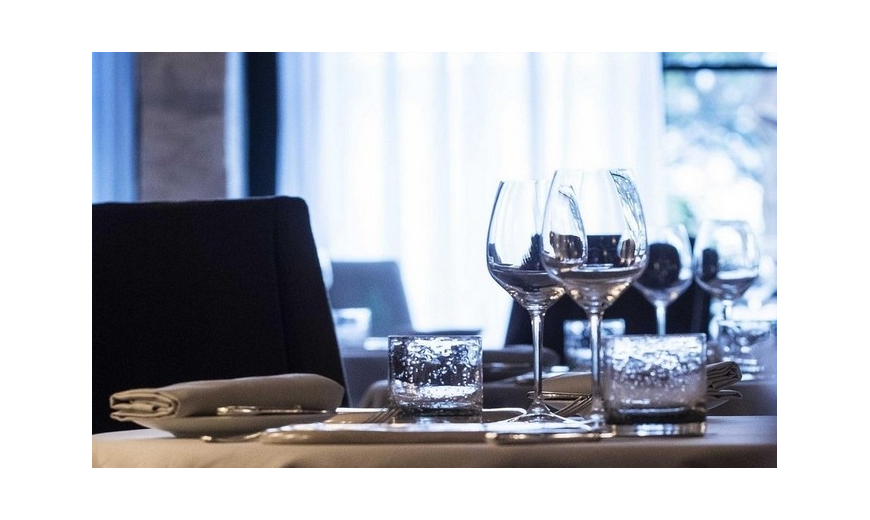
Illustration photo credit : L'Oustau de Baumanière
.
The table cloth
The more the meal is formal, the more the tablecloth must be sober and monochrome. A white table cloth is quite obligatory for lavish meals.
The more the meal is friendly and casual, the more the tablecloth can present color and patterns.
Ideally, it must exceed from the table from 20 to 30cm.
If you want to cover the entire height of the table, remember to leave at least a few inches free on the ground so that your guests are not embarrassed to slide their feet under the table.
The folds caused by rectangular tables must be organized in the length.
Trick: A fleece placed under the table cloth dampens the sounds, improves the comfort of the guests and protects your table!
.
Napkins
Napkins should always match the tablecloth and the table decoration.
They are usually placed in the center of the plate for lunch and on the side (preferably left side) for a dinner. English tradition presents them on the bread plate.
.
Place setting
A place setting get together all the table accessories necessary for each guest (cutlery, plates, glasses ...).
Ideally, each place setting should occupy 70cm. For the guests comfort, it is better to avoid going down below 60cm.
The place setting must be placed, between 1 and 3cm from the edge of the table.

.
Plates
More the dinner is formal, more there are plates on table.
Frecnh tradition use to limit to 3 plates that symbolize the 3 dishes of a classic meal (starter, fish, meat), stacked from the widest to the narrowest.
If it is planned to serve more dishes, each additional plate and its cutlery associated are usually brought at the time of service so as not to clutter the table and annoy the guests.
For a classical presentation, the presentation plate - never used except to give an aesthetical frame during the meal - is placed first. It remains in place throughout the meal, and is removed only to serve the dessert.
Main course plate is placed above, than the starter plate.
It is common to place a fourth plate above the forks and aligned to the glasses. It is the bread plate, where a spreader or a butter knife is usullay placed.
.
Cutlery
For the meal
Flatware is placed on both sides of the plates in menu order: from the outside (first course served) to the plate (last course served).
Top of the handle must be aligned to the larger plate.
Generally, table fork and table knife, which are for the main course, are next to the plate.
KnIves are placed on the rIght of the plate (II), cutting edge turned to the plate, Forks are on the leFt (FF). This logic is actually practical, as each piece is placed on the side of the hand that will use it.
So, the table spoon (soup spoon), is placed on the right side, near the knives, when it is requested for a course, for sure.
Forks and spoons are placed tip on the table in the french tradition (so as to see armorial bearings stamped on the back of the handle) and tip in the air in the english tradition. All forks and spoons on the table must be placed following the same tradition.
Trick: If you plan to serve a pan-fried meat, consider placing a steak knife instead of a table knife.
.
For dessert
In order not to clutter the table, the dessert cutlery are preferably brought only at the time of dessert.
If they are part of the place setting, they must be placed horizontally between plate and glasses.
Dessert knife is placed near the glasses, cutting edgce turned to the plate, handle on the right, as it will be used by the right hand.
The dessert spoon is placed in the same way. Then, near the plate, the dessert fork is placed handle on the left.
.
Glasses
Water and wine glasses
They are arranged from right to left in capacity order.
The right glass is the one with the smallest capacity, usually the white wine glass.
The red wine glasse is placed next, then, the water glass, with the biggest capacity.
The red wine glass is placed above the tip of the table knife.
The french tradition organizes glasses following an angle while they are presented in a horizontal line in the english tradition.
.
Flute or champagne cup
If you consider to serve champagne, flute or champagne cup is placed behind dinner glasses, between the water and red wine glasses in the french tradition, and aligned on the left of the water glass in the english tradition.
.
Accessories
They contribute to the elegance of the meal. A bread plate, salt and pepper (1 to 4 guests), a butter dish... all are accessories that improve the tasting moment.
However, be aware that the knife holder, often seen as a sophisticated accessory, was in fact originally used only during humble meals where the same knife was kept for different dishes. It allowed to not stain the tablecloth that could be reused for the next meal!
.
Table decoration
Photophores, flowers, objects… Table decoration must be the result of you creativity, and the expression of your tastes. It can also set meal theme.
It must always be thought in harmony with your table cloth and place setting.
Trick: Think light ! Table decoration must not prevent the guests from seeing each other or hinder the service.
Now, BON APPETIT !