


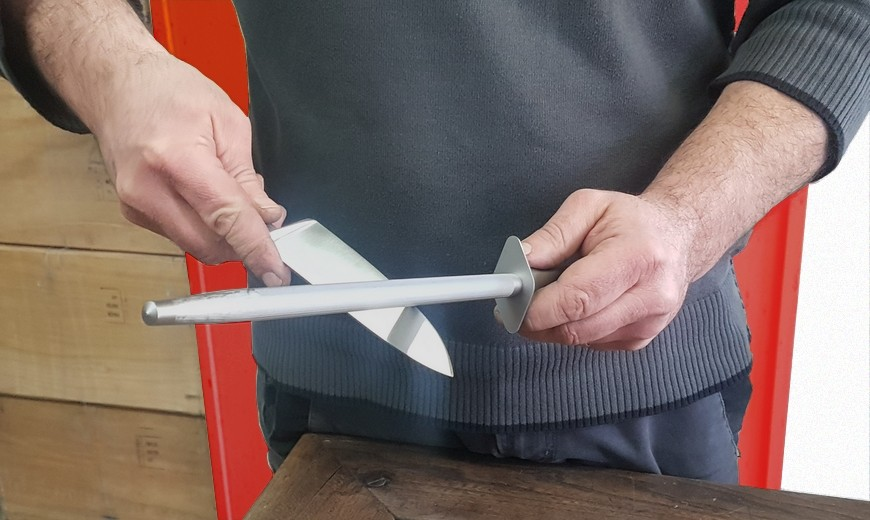
You got a good knife but the cutting quality is not as good as it was ?
You want to maintain the cutting quality of your knife so that it can cut as it did on its first use ?
Here are some tips to know to keep your knife all life long.
1) Technical terms difficult to understand... and translate !
In the french language, several terms are used to talk about "knife sharpening". It is difficult to understand the difference between each words even for french people!
However, these different words are existing for a good reason : they describe several levels of blade maintenance.
We try below to translate these technical terms in order to help you to better understand our purpose. We hope we do not go wrong.
- - [FR : Aiguiser] - that we translate by Grinding: To create or recreate the cutting edge by removing steel in order to make the blade thinner.
- - [FR : Affûter] - that we translate by Sharpening: To maintain the sharpness of the knife so that it keeps a good cutting quality. Term often used in the common language for all that concerns the maintenance of the cutting edge.
- - [FR : Affiler] - that we translate by Honing or whetting : To make the cutting edge perfectly sharp. This must be done after use or after sharpening, by removing asperities created by the contact of the blade with food, a support or a sharpening tool.
2) When is it necessary to work on your blade ?
Before buying anything to maintain your blade's cutting edge, remember that you have to maintain your knife before it doesn't cut anymore.
There is not written rule on the subject but we can say that honing* must be made regularly, sharpening* often and grinding* the less possible !
Your knife does not cut anymore and, reading these lines, you think that it is too late ?
Rest assured, solutions are existing; they however require some know-how. If you have any doubt and don't want to damage your knife : consult a professional.
3) How is YOUR knife ?
Before anything, you must know what kind of knife you have in hand :
- - A knife with a serrated edge cant' be ground, sharpened nor honed.
- - The kind of steel, the blade hardness, the kind of grinding, the blade length, will give you details about the sharpening tool that you will have to use.
- - To use a tool that is not suited to the quality of your knife (too much or not enough) is like not maintaining your knife.
- - Your knife must be ground, sharpen or honed ? The quality of the tool that you will have to use will depends on your reply to this question.
- - More the steel, its treatment and the manufacturing of the blade are qualitative, less your knife will require maintenance.
4) Which tool ?
Several tools are existing for the cutting edge maintenance. If all talk about "sharpening", it is indeed their performance, their grain, their material which precise if they are able to ground, sharpen or honed.
Some of them can be used immediately, some other needs a more or less long training period to be well used.
Among the more used ones, we talk about:
- - the sharpening steel (knife sharpener)
- - whetstone, natural, composite or ceramic
- - electrical or mechanical knife sharpener (machine)
in the article: [HOW "TO SHARPEN" A KNIFE - 2/2]